By the late summer of 2020, AMC Holdings (AMC) was a struggling movie theater chain brought one step closer to bankruptcy by COVID-19. Streaming services like Netflix had already resulted in fewer consumer trips to the cinema (and fewer sales of soda and popcorn), and then the pandemic completely shut AMC down. GameStop Corp. (GME) faced an equally dire situation. The nation’s largest brick-and-mortar video game retailer, its main profit-making segment (reselling used consoles and games) had been declining for a decade as the gaming industry moved from physical copies of games to digital downloads of the latest hits such as Minecraft and Fortnite. Then, due to COVID, it too had to close its locations.
As pandemic-related restrictions eventually eased, the retail locations of both companies began to reopen. Other than this marginally bright bit of news, however, no new major potential earnings drivers emerged for either company. Yet despite that fact, any investor looking at the five-year stock chart of both AMC and GME (below) might reasonably conclude that both companies had reinvented themselves.
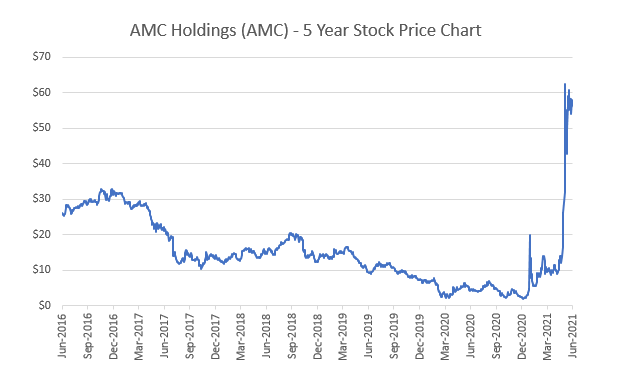
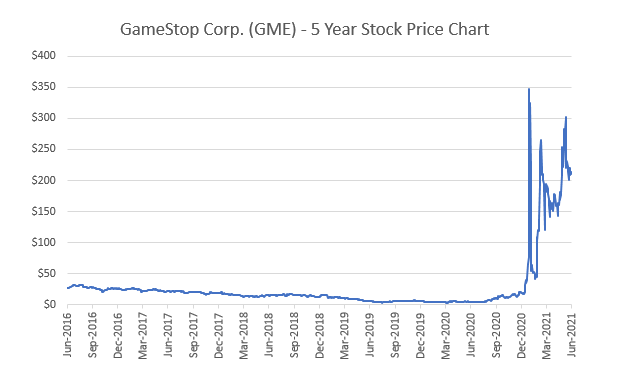
In reality neither company has made any significant move toward greater long-term profitability, yet both stocks have become retail investor favorites. What happened? The run-up in AMC and GME was driven by social media and the perceived wisdom of the crowd—or the Reddit mob. (Reddit is a social media website where individuals can connect and discuss a diverse range of topics.) In our opinion, neither stock price reflects the fundamental long-term prospects for either business. Instead, they represent a perceived battle between retail investors and Wall Street—perfect examples of so-called meme stocks.
As lockdowns have ended, AMC has reopened its doors and is showing movies again but finds itself increasingly in competition with studios streaming their movies directly to consumers. In addition, the company is saddled with debt. Its prior strategy of borrowing to buy other theater chains left it with a crippled balance sheet. (Too much debt limits any corporation’s options during downturns). At least AMC was able to use the rapid stock price increase to issue more shares, which raised much needed cash and provided a temporary financial lifeline.
Meanwhile, GME replaced most of its management team and brought in the founder of online-pet food company Chewy as its new chairman. While there are potential new business lines the new team could pursue, profitability in new segments is hard to create from scratch.
Why now?
We might ask what changed in the world to spark the sudden, dramatic, and hard-to-justify turnarounds in the stock prices of these two companies. There are many possible catalysts for why this occurred in 2021—the pandemic, shutdowns, government stimulus. But we should note this type of investor behavior is not without precedent. While not nearly as organized, something similar got its start on the Yahoo message boards during the dot-com boom and bust in the late ’90s.
This time around, these are the conditions that came together to drive the phenomenon:
- When COVID-19 hit, the personal saving rate of Americans skyrocketed. Aside from online shopping, consumers quite literally could not spend money even if they wanted to. This led to a larger than normal amount of cash on the sidelines, which was also earning nothing in savings or money market accounts due to the Federal Reserve slashing interest rates.
- The U.S. stock market started to rebound in late-March 2020, at the same time that many young adults were stuck at home either unemployed (and receiving significant government stimulus payments) or working from home with increased savings. The rising stock market may have piqued their curiosity as stocks hit all-time highs repeatedly in the latter half of the year, despite a raging pandemic.
- Crowd behavior is amplified on the internet. Subscribers to the subreddit WallStreetBets (a specific group on Reddit) ballooned from 1 million when COVID-19 started to over 6 million by the end of 2020. Rapid stock appreciation, often seen as a quick way to make money, results in both the fear of missing out (FOMO) and a form of mob mentality driven by emotion. GME and AMC were highlighted online by several individuals as “deep value” stocks for several reasons, including the number of shares that were held short by hedge funds who had bet the price would decline. This was one way the movement became somewhat of a crusade against Wall Street.
- Finally, retail investors found they could now trade stocks for zero commission, removing one of the final friction points for day traders and other short-term speculators. Robinhood Financial, an online broker, targeted meme investors by offering zero commission stock and option trading. They also offered fractional share orders (the ability to buy less than one share of stock), a millennial-friendly cell phone app, and promotions for traders with little money to invest, all of which succeeded in attracting new, younger investors looking to get in on the action.
Who’s in charge and what do they want?
It appears that retail traders are driving much of the price movement in AMC Holdings, GameStop, and other meme stocks. Using leverage through margin accounts (borrowing against the value of their account to buy even more shares), retail traders have become a much larger presence in the stock market over the past 12 months than they have in the past. While many post on message boards that they are trying to “stick it to the man” by showing Wall Street that they can keep these companies alive, most are likely trying to make a quick buck riding a wave of momentum.
On the other side of the trade, several hedge funds lost significant amounts of money betting these companies would fail, further emboldening the Reddit mob. At the same time, it is a guarantee that other institutional investors are finding ways to make money from the extreme volatility of the meme stocks as seen in the charts above.
How will this play out over the long-term?
In our opinion, the price of any meme stock will eventually revert to the underlying value of the business and its future potential earnings. Bubbles and manias have been well documented throughout history and we would simply add this to the list. We are concerned, however, that at the end of the day, if and when these stocks fall back closer to their fair value, it will be unprepared retail traders left holding the falling shares, not large institutions, hedge funds, or Wall Street.
For those that may be inclined to run with the meme crowd, we say “tread carefully.”